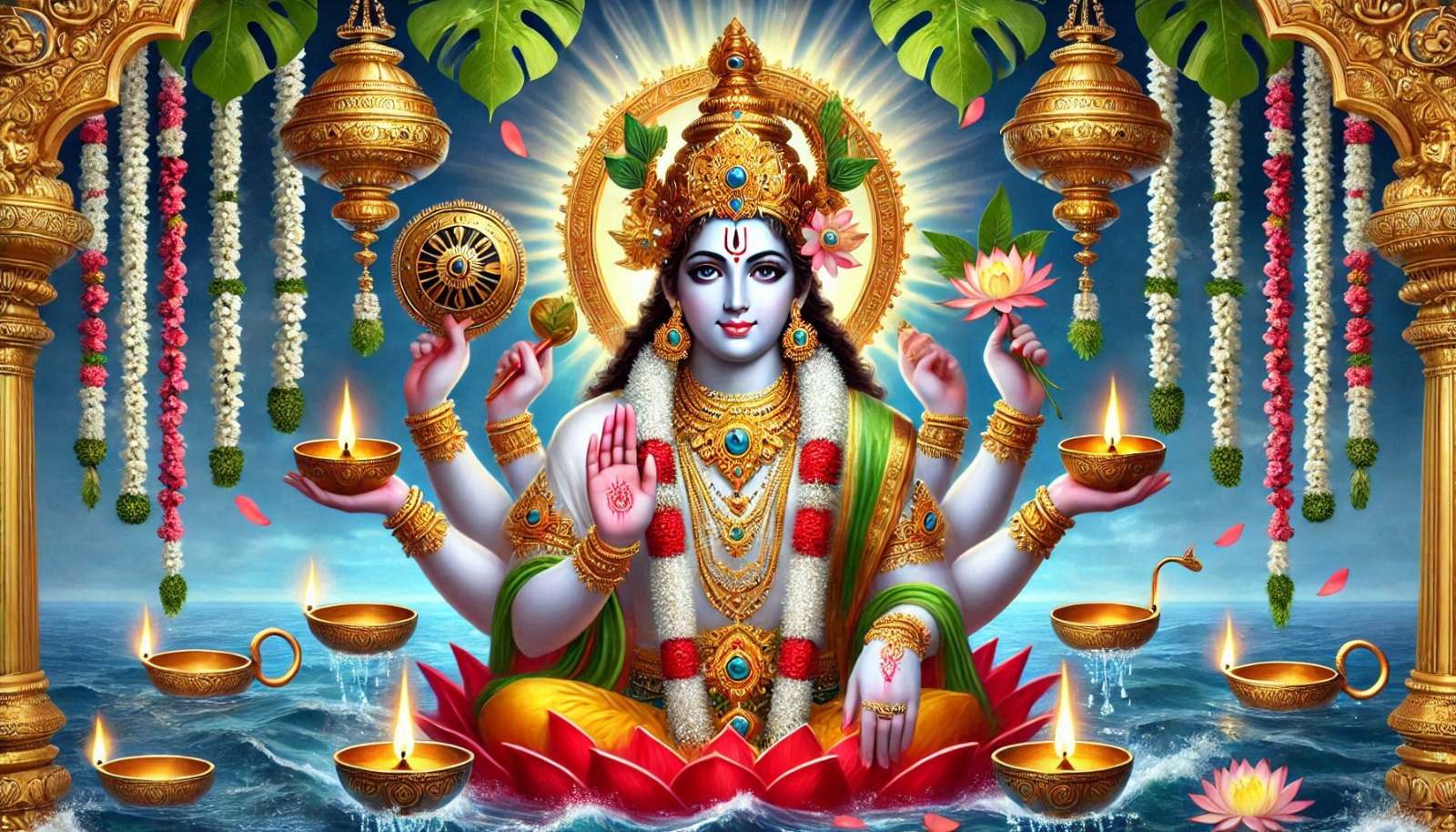
Putrada Ekadashi Puja for Blessed Progeny and Family Wellbeing
 Sunday 23 August, 2026
Puja will be held at Shri AdiNarayana Perumal Temple, Coimbatore, and you can experience from your home!
Putrada Ekadashi, also known as Shravana Putrada Ekadashi, Pavitropana Ekadashi and Pavitra Ekadashi, falls on the eleventh tithi of Shukla Paksha in the month of Shravan. As per the Bhavishya Purana, this vrat was observed by King Mahijit and Rani Chandrabhaga on the guidance of Sage Lomesh, and Bhagwan Vishnu blessed them with a son who later became known as Harishchandra. At Jyotirgamaya, our Vedic purohits perform authentic Putrada Ekadashi puja with proper sankalp in your name and gotra, so you can receive the seva benefits from anywhere in the world.
- Shriman Narayana Panchamrut Abhisheka Seva: Panchamrut and Dhravya Abhisheka to Bhagwan Vishnu, ideal for cleansing obstacles and inviting purity into your life.
- Shriman Narayana Sarva Seva: Panchamrut and Dhravya Abhisheka with Sarvalankara of Lotus and Tulasi, Tulasi Pushpa Archana, Naivedya and Mangalaarti, for complete blessings of prosperity and progeny.
- Maha Puja Seva: A grand seva with Panchamrut and Dhravya Abhisheka, Sarvalankara, Vishesha Naivedya of pancha phala and coconut, and Grand Tulasi Haar Samarpan, performed for couples seeking the blessing of a child and strong family bonds.
- Shri Vishnu Sahasranama Parayana Seva: Chanting of the Vishnu Sahasranama with Archana, Naivedya and Mangalaarti, known to bring peace of mind and remove sins accumulated over lifetimes.

Vedic Significance

Blessing of Progeny
Bhagwan Vishnu blessed King Mahijit and Rani Chandrabhaga with a son after their sincere Ekadashi vrat, giving this tithi its name Putrada, the giver of a child.

Karmic Release
Observed in Shravan month, this Ekadashi is also called Pavitropana, when devotees offer a sacred pavitra thread to Bhagwan Vishnu to cleanse past karma and doshas.

Merit Through Bhakti
Fasting and worship on this tithi is described in the Bhavishya Purana as one of the most fruitful vratas, granting punya equal to many other sacred observances combined.

Continuity of Lineage
This Ekadashi strengthens family dharma by seeking wellbeing, protection and moral growth for children, making it a vrat for the health and continuity of the whole family line.
Sevas we offer for Putrada Ekadashi Puja
Divine Story, Benefits, and Sacred Sevas of this Auspicious Puja
Vrat Katha (Story)
The story of this Ekadashi comes from the Bhavishya Purana, narrated by Bhagwan Krishna to King Yudhishthira.
There once lived a king named Mahijit who ruled his kingdom with fairness and devotion, yet he and his wife Rani Chandrabhaga remained without a child despite years of prayer. Deeply troubled, the king sought the counsel of forest sages during a hunting expedition. He met Sage Lomesh and shared his sorrow. The sage, moved by the king's sincerity, explained that in his past life the king had denied water to a thirsty cow, and this karma had delayed the blessing of a child in this life.
Sage Lomesh then guided the king and queen to observe the vrat of Shravana Putrada Ekadashi with complete devotion, fasting and worshipping Bhagwan Vishnu with full faith. The royal couple followed the sage's instructions exactly, keeping the fast and performing the puja on the correct tithi. Pleased with their devotion, Bhagwan Vishnu blessed them with a son who grew up to become the noble king Harishchandra, remembered for his truthfulness and dharma.
This katha is read or recalled during the vrat, as it forms the basis of why this Ekadashi is associated with the blessing of progeny and the clearing of past karma that stands in its way.
Other Names of This Ekadashi
Shravana Putrada Ekadashi is known by several names across India, each pointing to a different aspect of its significance.
- Shravana Putrada Ekadashi: The most common name, marking that this Ekadashi falls in the month of Shravan and is observed for the blessing of children. Putrada means giver of a child.
- Pavitropana Ekadashi: On this day, devotees offer a pavitra, a sacred thread, to Bhagwan Vishnu. Pavitropana refers to this act of offering purity through the thread.
- Pavitra Ekadashi: A shorter form of the same name, referring to the same pavitra offering ritual performed to seek forgiveness for unknown sins and karmic purification.
All three names refer to the same Ekadashi, and you will find it called by any of these across different regions and panchangs.
Significance and Benefits of Observing Putrada Ekadashi
Shravana Putrada Ekadashi holds a special place among the twenty four Ekadashis observed through the year. The Bhavishya Purana describes it as a vrat that grants results equal to performing several other sacred observances together, making it one of the most fruitful fasting days in the Hindu calendar.
For couples who wish for a child, this Ekadashi is observed with the belief that sincere fasting and worship of Bhagwan Vishnu can clear the karmic obstacles standing in the way of parenthood, as shown in the story of King Mahijit. The pavitra offered on this day is also seen as a way to seek forgiveness for sins committed knowingly or unknowingly, offering a sense of karmic cleansing that extends beyond the wish for children.
Beyond progeny, the vrat is observed for the general wellbeing, protection and moral upbringing of children already in the family, making it relevant for parents as well as those still hoping to become parents. Since it falls within the holy month of Shravan, a month already dedicated to devotion and self discipline, the merit of fasting and puja on this day is considered further amplified. Devotees who cannot fast personally often choose to have the puja performed on their behalf, receiving the same sankalp based benefits through seva.
Our Puja Sevas (Detailed)
We offer four levels of seva for Putrada Ekadashi, performed by experienced Vedic purohits with sankalp taken in your name and gotra.
1. Shriman Narayana Panchamrut Abhisheka Seva: This seva includes Panchamrut Abhisheka, a bath of five sacred substances, along with Dhravya Abhisheka to the deity of Bhagwan Vishnu. It is a simple yet powerful seva suited for those seeking purification and removal of obstacles.
Best suited for: First time devotees or those seeking a focused, simple seva for karmic cleansing.
2. Shriman Narayana Sarva Seva: This seva includes Panchamrut and Dhravya Abhisheka, Sarvalankara with Lotus and Tulasi, Tulasi Pushpa Archana, Naivedya and Mangalaarti. It offers a more complete worship experience with adornment and floral offerings.
Best suited for: Devotees seeking blessings for family prosperity along with karmic purification.
3. Maha Puja Seva: Our most elaborate seva, including Panchamrut and Dhravya Abhisheka, Sarvalankara with Lotus and Tulasi, Tulasi Pushpa Archana, Mangalaarti, Vishesha Naivedya of pancha phala and coconut, and Grand Tulasi Haar Samarpan.
Best suited for: Couples specifically seeking the blessing of a child, and families wanting the fullest form of this seva.
4. Shri Vishnu Sahasranama Parayana Seva: This seva includes the chanting of Shri Vishnu Sahasranama, followed by Archana, Naivedya and Mangalaarti.
Best suited for: Devotees seeking peace of mind, protection from doshas, and the merit of reciting the thousand names of Bhagwan Vishnu.
Puja Vidhi (Ritual Process We Follow)
Our purohits follow the traditional order of worship for Putrada Ekadashi, performed on your behalf with your sankalp.
- Sankalp is taken in your name and gotra, stating the purpose of the puja.
- The deity of Bhagwan Vishnu is prepared with Kalasha sthapana and invocation.
- Panchamrut Abhisheka is performed using milk, curd, honey, ghee and sugar, followed by Dhravya Abhisheka.
- Sarvalankara is offered with Lotus and Tulasi, dressing the deity in a complete form of adornment (in Sarva Seva and Maha Puja).
- Tulasi Pushpa Archana is performed, chanting the names of Bhagwan Vishnu with each flower offering.
- Vishesha Naivedya of pancha phala and coconut is offered, along with the Grand Tulasi Haar for the Maha Puja seva.
- For the Parayana seva, Vishnu Sahasranama is chanted in full, followed by Archana.
- The puja concludes with Mangalaarti, and prasad is prepared for delivery to devotees.
Who Should Observe This Ekadashi
- Couples seeking a child: As per the story of King Mahijit and Rani Chandrabhaga, this Ekadashi is especially observed by couples wishing for the blessing of progeny.
- Parents of existing children: The vrat is also kept for the health, protection and moral growth of children already born into the family.
- Devotees seeking general punya: Since this is one of the more fruitful Ekadashis as per the Bhavishya Purana, many devotees observe it purely for spiritual merit and Vishnu bhakti.
- NRI families: Devotees living in the USA, UK, Canada, UAE and Australia who cannot travel to India or fast without guidance can have this puja performed on their behalf, with live streaming access and prasad delivery where available.
Fasting Guidelines (Vrat Niyam)
For those who wish to observe the fast personally alongside booking the seva:
- Begin the vrat with sankalp on the morning of Ekadashi.
- Avoid rice and grains on the day of fasting, and rely on fruits or phalahar if a full nirjala fast is not possible.
- Avoid tamasic food, alcohol and negative speech through the day.
- Spend the day in worship of Bhagwan Vishnu, chanting his names and reading the Vrat Katha.
- Break the fast, or parana, only after sunrise on Dwadashi, and avoid breaking it during Hari Vasara, the first quarter of Dwadashi.
- Those with health conditions, pregnant women, and elderly devotees may observe a simpler phalahar fast rather than a strict nirjala fast, as per family or sampradaya custom.
Scriptural References
The story and significance of Shravana Putrada Ekadashi are described in the Bhavishya Purana, where Bhagwan Krishna narrates the katha of King Mahijit to King Yudhishthira. The observance of Ekadashi vrats and their connection to Vishnu bhakti is also supported by references across classical Jyotish and Puranic tradition, which describe fasting on this tithi as one of the most meritorious observances of the Hindu calendar.
Why attend puja online with us?
In the spiritual realm, physical boundaries hold no power, ensuring a connection between you and the divine.

Live Ritual Viewing
Experience the spiritual essence from the comfort of your home by tuning into live streams of the rituals performed by experienced priests.

Recorded Ceremony Video
If you miss the live event, a recorded video will be provided, allowing you to watch the sacred rituals at your convenience.

Free Prasad Delivery
Receive blessed prasad delivered directly to your home, ensuring you remain connected to the divine blessings.

Convenience
Participate in the rituals remotely without the need to visit the temple.

Spiritual Connection
Stay spiritually connected through live and recorded rituals, with blessings brought to you through prasad delivery.
How to book Putrada Ekadashi Puja puja
1
Choose your seva
Select one or more main rituals as per your spiritual need.
2
Choose offerings
Add optional offerings to deepen your spiritual experience.

3
Complete your booking
Confirm securely so all selected rituals and offerings are included.
Click Here To Book Puja
Do not let distance or a busy schedule keep you from this sacred Ekadashi. Book your Putrada Ekadashi Puja with Jyotirgamaya today, and let our experienced Vedic purohits perform the complete Panchamrut Abhisheka, Sarvalankara and Naivedya rituals on your behalf, with sankalp taken in your name and gotra. Whether you are seeking the blessing of a child, praying for the wellbeing of your family, or simply wish to gain the punya of this auspicious tithi, choose the seva that fits your intention and let Bhagwan Vishnu's kripa reach you, wherever in the world you are. Reserve your seva now and receive prasad and puja updates directly to you.
FAQs.
Q. When is Putrada Ekadashi in 2026?
Shravana Putrada Ekadashi falls on Sunday, August 23, 2026 for those following the Smarta tradition, and on Monday, August 24, 2026 for those following the Vaishnava tradition.
Q. What is the difference between Pausha and Shravana Putrada Ekadashi?
There are two Putrada Ekadashis in a year, one in the month of Pausha (December to January) and one in Shravan (July to August). Both carry the same name and significance, and are observed for the blessing of children.
Q. Why is it also called Pavitropana or Pavitra Ekadashi?
On this day devotees offer a pavitra, a sacred thread, to Bhagwan Vishnu, seeking forgiveness for unknown sins. This ritual gives the Ekadashi its other names, Pavitropana and Pavitra Ekadashi.
Q. Can I book this puja if I live outside India?
Yes. Devotees from the USA, UK, Canada, UAE, Australia and other countries can book any of our Putrada Ekadashi sevas online, with sankalp performed in your name and gotra, and prasad delivered where our shipping is available.
Q. Which seva should I choose if I am seeking the blessing of a child?
The Maha Puja Seva is our most complete offering for this purpose, including full Abhisheka, Sarvalankara, Vishesha Naivedya and Grand Tulasi Haar Samarpan, closely following the tradition described in the katha of King Mahijit.
Q. Do I need to fast personally if I book a seva?
No. While personal fasting is encouraged for those who are able, booking a seva allows our purohits to perform the puja and sankalp on your behalf, and you receive the benefits of the ritual even without a personal fast.
Please note:The temple mentioned above may change based on certain on-ground dynamics. However, please be assured that the puja will definitely be conducted in an appropriate temple without any compromise.
Upcoming dates for Same Puja
12 August 2027
1 August 2028
20 August 2029