Trimbakeshwar Pitru Paksha Puja 2026: Online Shradh, Tarpan and Narayan Nag Bali Seva
 Saturday 10 October, 2026
Puja will be held at Trimbakeshwar (Maharashtra), and you can experience from your home!
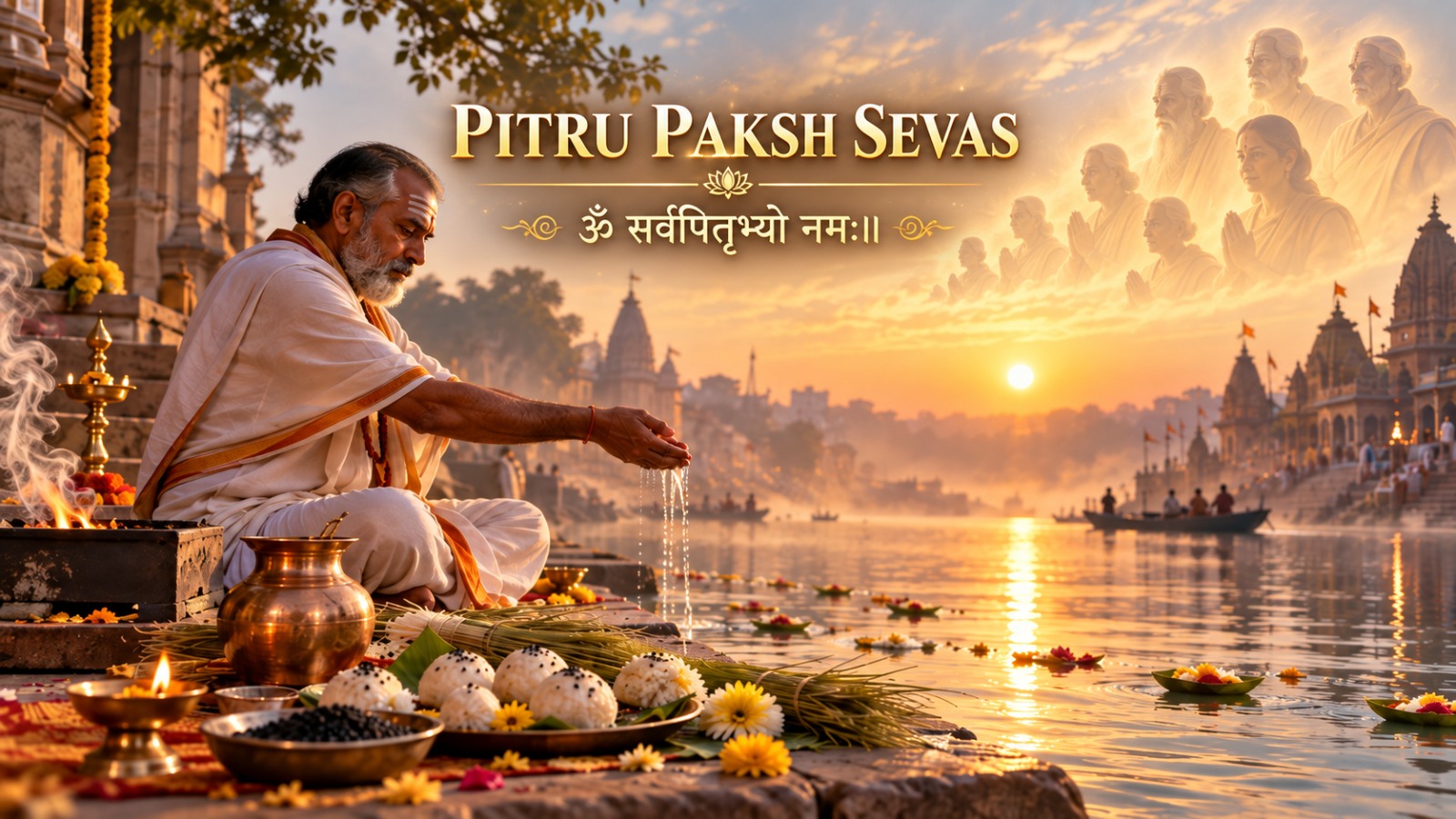
Trimbakeshwar in Nashik is the holy source of the Godavari and a Jyotirlinga of Bhagwan Shiva, and it is one of the most respected places in Bharat for Pitru Karma. With Jyotirgamaya, you can honor your ancestors here without travelling. Expert Trimbakeshwar pandits perform each seva in your name and gotra, and you watch it live on YouTube, with the recording saved for later. Samagri is included in every seva. All sevas are individual sevas, done in your name and gotra, and only Narayan Nag Bali is samoohik (group) seva.
- Shradh Seva: The main ritual of Pitru Paksha, done on the tithi of your family member's passing to thank ancestors and give them peace.
- Pitru Tarpan Seva: An offering of water, black til and kusha grass with mantras, believed to quench the thirst of Pitrs and please them.
- Tripindi Shradh Seva: Pind Daan for three generations of ancestors, done when Pitru trouble in the family is long standing.
- Pitru Dosha Nivaran Seva: A ritual to satisfy the Pitrs and reduce the effect of Pitru Dosha seen in the kundli or felt in family life.
- Narayan Nag Bali Seva: A special ritual for souls of accidental, sudden or unnatural death and for serpent related dosha, done at Trimbakeshwar, one of the best known places for it.
- Gau Puja Seva (Gaushala in South India): Worship of the cow with water, rice, jaggery and banana, believed to please Pitrs. Not live, but photos and a recording are shared.

Vedic Significance

Blessings of Pitrs
Satisfied Pitrs are believed to give health, long life, wealth and children. Shradh done with faith brings peace and protection to the family.

Power of Tarpan
Water offered with black til and kusha grass, with names and gotra, is believed to quench the thirst of ancestors and give them peace.

Shradh in the Shastras
The Garuda Purana, Vishnu Purana and Mahabharata teach Shradh and Pind Daan as a sacred duty, and Gaya is called the highest tirtha for it.

Repaying Pitru Rina
Every householder owes a debt to ancestors. Shradh is the Vedic way to repay it with gratitude, and it keeps family bonds strong across generations.
Sevas we offer for Trimbakeshwar Pitru Paksha Puja 2026
Divine Story, Benefits, and Sacred Sevas of this Auspicious Puja
Pitru Paksha 2026 sevas at Trimbakeshwar include Pitru Tarpan, Shradh, Narayan Nag Bali, Tripindi and Pitru Dosha Nivaran, held from 27 September to 10 October 2026. Expert Trimbakeshwar pandits perform each ritual in your name and gotra, and every Trimbakeshwar seva is shown live on YouTube with a recording for later. Samagri is included, and prices start from ₹1,901. A Pitru Dosha Nivaran Gau Puja Seva at Gaushala, from South India, is available for ₹1,001, with photos and a recording shared after the seva.
TRIMBAKESHWAR SEVA DETAILS
1. Shradh at Trimbakeshwar: Samagri included. Usual time: about 2 hours.
Also searched as: Shraddha, Shraaddha, Sraddha, Pitru Paksha Shradh, Annual Shradh, Tithi Shradh, Pitru Shradh, श्राद्ध, पितृ पक्ष श्राद्ध, तिथि श्राद्ध, वार्षिक श्राद्ध.
The pandit performs Shradh on the tithi of your family member's passing, with pind, til, water and food offerings, in your name and gotra. This is the main seva of Pitru Paksha. It is right for those who do yearly Shradh for a parent or grandparent, and for families who want to begin.
2. Pitru Tarpan at Trimbakeshwar: Samagri included. Usual time: about 1 hour.
Also searched as: Pitri Tarpan, Pitru Tarpana, Jal Tarpan, Tarpan Vidhi, पितृ तर्पण, जल तर्पण, तर्पण विधि.
The pandit offers water, black til and kusha grass to your Pitrs with Vedic mantras, using your family name and gotra. It is the right seva for families who want to honor their ancestors in Pitru Paksha and cannot do Tarpan at home.
3. Tripindi Shradh at Trimbakeshwar: Samagri included. Usual time: about 3 hours.
Also searched as: Tripindi Shraddha, Tripindi Shraddh, Tripindi Puja, Tripindi Shradh Trimbakeshwar, त्रिपिंडी श्राद्ध, त्रिपिंडी पूजा.
Tripindi Shradh gives pind to three generations of ancestors. It is done when there is Pitru trouble in the family, such as repeated problems in marriage, children, health or career, or when family members passed away without proper rites, in childhood or unmarried.
4. Pitru Dosha Nivaran at Trimbakeshwar: Samagri included. Usual time: about 3 hours.
Also searched as: Pitra Dosh Nivaran, Pitri Dosha Puja, Pitru Dosh Shanti, Pitru Dosha Shanti Puja, पितृ दोष निवारण, पितृ दोष शांति पूजा.
This seva is for families who see signs of Pitru Dosha in their kundli, or who face long delays and troubles without a clear reason. The pandit performs the ritual to satisfy the Pitrs and to reduce the effect of the dosha.
5. Narayan Nag Bali at Trimbakeshwar: Samagri included. Usual time: 3 days, as per tradition. The live schedule for each day is shared with you.
Also searched as: Narayan Nagbali, Narayan Nag Bali Pooja, Narayan Nagbali Puja, Narayan Bali Nag Bali, नारायण नागबली, नारायण नागबली पूजा.
Narayan Nag Bali is done for souls who died by accident, suicide, sudden illness, in water, by fire, or without proper last rites. It is also done for dosha that comes from harming a serpent. The ritual is believed to give peace to such restless souls and to clear the obstacles they may cause in the family. Trimbakeshwar is one of the best known places in Bharat for this seva.
6. Pitru Dosha Nivaran Gau Puja Seva (Gaushala from South India): Samagri included. Not shown live. Photos and a recording are shared with you after the seva.
Also searched as: Gau Puja for Pitru Dosha, Gau Seva for Pitrs, Gau Mata Puja, Pitra Dosh Gau Seva, गौ सेवा, गौ पूजा, पितृ दोष गौ सेवा.
Add cow worship to your Pitru Karma. At a gaushala in South India, the cow is worshipped and offered water, rice, jaggery and banana in your name. This seva is done in South India and not at Trimbakeshwar.
Every seva on this page is an individual seva, and none are samoohik (group) sevas.
PITRU PAKSHA 2026 DATES
- Saturday, 26 September 2026: Purnima Shradh
- Sunday, 27 September 2026: Pratipada Shradh, the first day of the Krishna Paksha Shradh days
- Saturday, 10 October 2026: Sarva Pitru Amavasya (also called Mahalaya Amavasya, Pitri Amavasya or Amavasya Shradh)
Jyotirgamaya Trimbakeshwar sevas run from 27 September to 10 October 2026. Booking is open now and closes on 9 October 2026.
Shradh is done on the tithi (lunar day) on which your family member left the body, not on the English calendar date. If you know the tithi, tell us and the pandit will fix the right day. If you do not know it, Sarva Pitru Amavasya on 10 October 2026 is the day for all ancestors, known and unknown.
Pitru Paksha falls in the month of Bhadrapada in the Amanta calendar (used in Maharashtra, Karnataka, Andhra and Gujarat) and in Ashwin in the Purnimanta calendar (used in North India). The days are the same for everyone.
WHAT IS PITRU PAKSHA?
Pitru Paksha is a 15 day period of the year given fully to our ancestors. "Pitru" means forefathers and "Paksha" means a fortnight. It is also called Pitru Paksh, Pitri Paksha, Shradh Paksha, Shraddh Paksh, Mahalaya Paksha and Kanagat. In Maharashtra, people also say Pitru Pandharwada. In Andhra and Telangana, the last day is called Pedala Amavasya. In Tamil Nadu and Kerala, the rituals are known as Tharpanam and Shradham. In Hindi, people search for it as पितृ पक्ष, श्राद्ध पक्ष, श्राद्ध, तर्पण, पिंड दान and महालया अमावस्या. In Marathi, it is पितृपंधरवडा.
During these days, families offer water, til (sesame), food and pind (rice balls) to their ancestors through Tarpan, Shradh and Pind Daan. It is a time of gratitude, when we remember our parents, grandparents and all those in our family line who came before us.
WHY DO SHRADH AND TARPAN IN PITRU PAKSHA?
The Vedic view is simple. The soul does not end with the body. Our Pitrs (ancestors) live in Pitru Loka, and it is believed that in these days they come near their descendants and wait for offerings. Every householder carries three debts: Deva Rina (to Bhagwan and the devatas), Rishi Rina (to the sages and teachers) and Pitru Rina (to ancestors). Shradh is the way to repay Pitru Rina.
The Garuda Purana explains the journey of the soul after death and the importance of Pind Daan and Shradh. The Vishnu Purana has a full teaching on Shradh, and the Mahabharata (Anushasana Parva) has Bhishma Pitamah teaching Yudhishthira the duty of Shradh. The Rigveda has hymns to the Pitrs, known as Pitru Sukta. All these texts agree that what is offered with faith reaches our ancestors.
When Pitrs are satisfied, it is believed that they give Arogya (health), Ayushya (long life), Dhana (wealth) and Santati (children) to the family. When Shradh is left out for many years, Jyotish and Purana traditions speak of Pitru Dosha (also called Pitra Dosh or Pitri Dosha), which can show up as delay in marriage, trouble in having children, repeated illness, money loss or a feeling of being stuck in life.
SHRADH, TARPAN AND PIND DAAN: WHAT IS THE DIFFERENCE?
- Tarpan (Tarpana): Offering water mixed with black til and kusha grass to Pitrs while chanting their names, gotra and mantras. It is the simplest and most common Pitru Karma.
- Shradh (Shraddha, Shraaddha, Sraddha): A complete ritual done with faith, in which food, til, water and pind are offered to ancestors, and Brahmins are fed. The word comes from "shraddha", which means faith.
- Pind Daan (Pinda Dana): Offering pinda (rice balls made with til, barley flour and ghee) to the departed soul, believed to give it strength for its onward journey.
- Tripindi Shradh: A special Shradh with pind for three generations, done when the family faces trouble linked to unsatisfied ancestors.
- Narayan Nag Bali: A special ritual for souls who left the body in an unnatural or untimely way, and for dosha linked to harm done to serpents.
- Pitru Dosha Nivaran: A ritual done to calm the effects of Pitru Dosha seen in the birth chart or felt in family life.
WHY TRIMBAKESHWAR FOR PITRU KARMA?
Trimbakeshwar in Nashik is one of the twelve Jyotirlingas of Bhagwan Shiva. It is also the place where the river Godavari, called Dakshin Ganga, begins at the Brahmagiri hill, and where the sacred Kushavarta Kund stands. For many centuries, families have come here for Pitru Karma, and Trimbak is one of the best known places in Bharat for Narayan Nagbali, Tripindi Shradh and Pitru Dosha remedies. All Trimbakeshwar sevas on this page are done by expert Trimbakeshwar pandits.
WHICH SEVA IS RIGHT FOR MY FAMILY?
- You want to honor a parent or grandparent on their tithi: Shradh
- You want a simple offering during Pitru Paksha: Pitru Tarpan
- You do not know the tithi of death: Shradh or Tarpan on Sarva Pitru Amavasya, 10 October 2026.
- A family member died in an accident, by suicide, in water, by fire or suddenly: Narayan Nag Bali
- Your kundli shows Pitru Dosha, or there are long delays in marriage, children or career: Pitru Dosha Nivaran or Tripindi, with the Gau Puja Seva
Families can also book more than one seva.
TRIMBAKESHWAR OR GAYA: WHICH PLACE SHOULD I CHOOSE?
Trimbakeshwar is known for Narayan Nagbali, Tripindi Shradh and Pitru Dosha remedies, and it stands at the source of the Godavari. Gaya, in Bihar, is known as the highest place for Pind Daan and is linked with the liberation of Pitrs. Many families do yearly Shradh and Tarpan at Trimbakeshwar and choose Gaya for a special Pind Daan. Your family tradition and the advice of your family priest come first.
Also see our Gaya Pitru Paksha sevas: https://jyotirgamaya.online/pujas/gaya_pitru_paksha_shradh_pind_daan
WHY ADD THE PITRU DOSHA NIVARAN GAU PUJA SEVA?
In the Vedic tradition, the cow (Gau Mata) is held sacred, and it is said that all the devatas live in her. The Garuda Purana speaks of Gau Daan as help for the soul on its onward journey. Feeding and worshipping the cow is a simple and loved way to please the Pitrs.
At a gaushala, the cow is worshipped and offered water, rice, jaggery and banana in your name. It costs ₹1,001, and samagri is included. It is done in South India and not at Trimbakeshwar, and it is not shown live. Photos and a recording are shared with you afterwards. You can book it with any Trimbakeshwar seva or alone.
SIGNS OF PITRU DOSHA (AS SEEN IN JYOTISH)
Astrologers look at Pitru Dosha in the birth chart when the Sun, or the ninth house and its lord, is troubled by Rahu, Ketu or Shani. Families also describe it through these signs:
- Marriage is delayed again and again
- Trouble in having children, or problems with the health of children
- Money and career stuck for a long time without a reason
- Quarrels and unrest at home
- Bad dreams about ancestors
- Shradh was never done for someone who passed away
These are traditional signs and do not replace a proper kundli reading. If you want a Jyotish reading of your chart, you can also book a consultation with Jyotirgamaya.
WHO CAN PERFORM SHRADH AND TARPAN?
Traditionally the eldest son or a male member of the family performs Shradh. If there is no male member, many pandits guide that a daughter, wife or another family member can take the sankalp. For online seva, you give your details and the pandit takes the sankalp on your behalf, so anyone in the family can book. Share your situation and our team will guide you.
HOW THE ONLINE SEVA WORKS
- Choose your seva. Pick one or more sevas, and add the Gau seva if you wish.
- Share your details. Give the name of the person booking, gotra, and the name and tithi of your ancestor if you know it.
- Pandit takes sankalp. The Trimbakeshwar pandit performs the ritual in your name and gotra, on the right tithi, between 27 September and 10 October 2026.
- Watch live on YouTube. You get the link, so you can watch the Trimbakeshwar seva from home. The Gau seva is not live, and you get photos and a recording after it.
- Watch again anytime. The recording is saved on YouTube.
You can read this page in Hindi, Marathi, Kannada, Tamil, Telugu, Bengali and other languages using the language menu at the top of the page.
What you can do at home during the live seva
- Bathe and wear clean clothes
- Sit in a clean place. Many families face south during Pitru Karma
- Offer water with a little black til when the pandit does Tarpan
- Eat sattvic vegetarian food that day, and feed or donate food to the needy or a cow in the name of your ancestors
WHY BOOK PITRU PAKSHA SEVAS WITH JYOTIRGAMAYA?
- Pandits of Trimbakeshwar: Every Trimbakeshwar seva is done by expert Trimbakeshwar pandits.
- Live on YouTube: See your seva as it happens, with the recording saved for later.
- Correct tithi and vidhi: Rituals follow the scriptures and the tithi of your ancestor.
- Clear prices: The price of each seva is shown on this page, and samagri is included.
- Individual seva: Every seva is done in your name and gotra, and none are samoohik (group) sevas.
- Made for families who cannot travel: Especially for NRI families, and families who cannot reach Nashik during Pitru Paksha.
Why attend puja online with us?
In the spiritual realm, physical boundaries hold no power, ensuring a connection between you and the divine.

Live Ritual Viewing
Experience the spiritual essence from the comfort of your home by tuning into live streams of the rituals performed by experienced priests.

Recorded Ceremony Video
If you miss the live event, a recorded video will be provided, allowing you to watch the sacred rituals at your convenience.

Free Prasad Delivery
Receive blessed prasad delivered directly to your home, ensuring you remain connected to the divine blessings.

Convenience
Participate in the rituals remotely without the need to visit the temple.

Spiritual Connection
Stay spiritually connected through live and recorded rituals, with blessings brought to you through prasad delivery.
How to book Trimbakeshwar Pitru Paksha Puja 2026 puja
1
Choose your seva
Select one or more main rituals as per your spiritual need.

2
Choose offerings
Add optional offerings to deepen your spiritual experience.

3
Complete your booking
Confirm securely so all selected rituals and offerings are included.
Click Here To Book Puja
BOOK YOUR PITRU PAKSHA SEVA AT TRIMBAKESHWAR
Pitru Paksha comes once a year, and these days are the best time to honor your ancestors. Choose your seva at Trimbakeshwar, share your details, and watch it live from home. May your Pitrs be at peace, and may their ashirwad stay with your family.
Book Trimbakeshwar Seva Now
FREQUENTLY ASKED QUESTIONS
Q. When is Pitru Paksha 2026? (Pitru Paksh kab hai? पितृ पक्ष 2026 कब से कब तक है?)
Pitru Paksha 2026 starts with Purnima Shradh on 26 September and Pratipada Shradh on 27 September. It ends with Sarva Pitru Amavasya (Mahalaya Amavasya) on Saturday, 10 October 2026. Jyotirgamaya sevas run from 27 September to 10 October 2026.
Q. Can Shradh be done online? (Online Shradh kaise kare? ऑनलाइन श्राद्ध)
Yes. At Jyotirgamaya, expert pandits at Trimbakeshwar perform the full Shradh in your name and gotra, and you watch it live on YouTube. Many families who live far away or abroad choose this. Families who can travel may also choose to be present in person.
Q. What is the difference between Shradh, Tarpan and Pind Daan? (श्राद्ध, तर्पण और पिंड दान में क्या अंतर है?)
Tarpan is an offering of water with til. Shradh is a fuller ritual with food, pind and feeding of Brahmins. Pind Daan is the offering of rice balls (pinda) to the departed soul. All three are part of Pitru Karma and are often done together.
Q. What if I do not know the tithi of my ancestor's death? (Tithi pata na ho to Shradh kab kare?)
Do Shradh or Tarpan on Sarva Pitru Amavasya, which is Saturday, 10 October 2026. This day is for all ancestors, whether known or unknown.
Q. How much does Narayan Nag Bali cost at Trimbakeshwar?
Narayan Nag Bali at Trimbakeshwar is ₹9,901, and samagri is included.
Q. How much does Tripindi Shradh cost at Trimbakeshwar?
Tripindi Shradh at Trimbakeshwar is ₹4,501, and samagri is included.
Q. How much does Shradh, Tarpan and Pitru Dosha Nivaran cost at Trimbakeshwar?
Shradh is ₹1,901, Pitru Tarpan is ₹2,501 and Pitru Dosha Nivaran is ₹6,901. Samagri is included in each.
Q. What is the difference between Narayan Nag Bali and Tripindi Shradh?
Narayan Nag Bali is done for souls who died in an unnatural or untimely way and for serpent related dosha. Tripindi Shradh offers pind to three generations of ancestors and is done for Pitru troubles in the family line. Some families do both. Our team can guide you on what fits your case.
Q. What is the Pitru Dosha Nivaran Gau Puja Seva?
It is a seva for ₹1,001 in which the cow is worshipped with offerings of water, rice, jaggery and banana in your name, at a gaushala. It is done in South India and not at Trimbakeshwar. It is not shown live, but photos and a recording are shared with you after the seva.
Q. Which is better, Trimbakeshwar or Gaya?
Both are holy for Pitru Karma. Trimbakeshwar is well known for Narayan Nagbali, Tripindi Shradh and Pitru Dosha remedies, and Gaya is known as the highest place for Pind Daan. Many families use both. Follow your family tradition and the advice of your priest.
Q. Can women perform Shradh and Tarpan?
Traditionally the male members do it, but when there is no male member, many pandits guide that a daughter, wife or other family member can take the sankalp. For online seva, the pandit takes the sankalp for you. Share your situation and our team will guide you.
Q. What details do I need to give for the seva?
Your name, gotra, the name of the ancestor, and the tithi or date of passing if you know it. If you do not know the gotra, the pandit will use the standard method for it.
Q. Will I see the seva live?
Yes. All Trimbakeshwar sevas are shown live on YouTube, and the recording is saved on YouTube for you to watch again. The Gau seva at the gaushala is not live, but photos and a recording are shared with you after it is done.
Q. Are these sevas individual or samoohik (group)?
All sevas are individual sevas, done in your name and gotra. None of them are samoohik (group) sevas.
Q. Is samagri included in the seva price?
Yes. Samagri (all puja materials) is included in the price of every seva.
Q. How long does each seva take?
Usual time is about 1 hour for Pitru Tarpan, about 2 hours for Shradh, about 3 hours for Tripindi and Pitru Dosha Nivaran, and 3 days for Narayan Nag Bali. The exact live time and YouTube link are shared with you before your seva.
Q. Can I do Shradh if Pitru Paksha has passed?
Pitru Paksha is the best time. If you miss it, Amavasya of any month is another option.
Q. Should I do Pitru Paksha Shradh if I do not have Pitru Dosha?
Yes. Shradh is not only for dosha. It is the yearly duty of every family to remember and thank their ancestors.
Q. Until when can I book?
Booking is open now and closes on 9 October 2026. Sevas run from 27 September to 10 October 2026.
Upcoming dates for Same Puja
15 September 2027
3 September 2028
22 September 2029